

As Prime Minister Narendra Modi’s Israel visit begins on Wednesday, his Israeli counterpart, Benjamin Netanyahu, announced that his trip will forge a new alliance to counter what he described as “radical” adversaries.
“In the vision I see before me, we will create an entire system, essentially a ‘hexagon’ of alliances around or within the Middle East,” the Israeli leader said. Calling India a “global power” and PM Modi a “personal friend”, Netanyahu said that the relationship between the two countries has “grown tighter”.
What Is The Hexagon Of Alliances?
The “hexagon” of alliances includes countries like India, Arab nations, African nations, Mediterranean nations (Greece and Cyprus) and other undisclosed nations in Asia.
The description broadly matches the vision of IMEC, the India-Middle East-Europe Economic Corridor, which aims to bolster economic development by fostering connectivity.
The alliance aims to create an axis of nations that agrees on the reality, challenges and goals against radical axes, namely the Shia axis and the Sunni axis. The Israeli leader said that the nations included in the alliance share different perceptions and added that the cooperation between them could give great results and ensure their “resilience and future”.
India As A “Global Power” Anchor
Although PM Modi praised the relationship between India and Israel as one built on trust and with a shared commitment to peace, New Delhi has historically steered clear of rigid bloc politics, remaining fluid in its engagements with China, Russia and the US alike.
Moreover, India also enjoys close relations with Iran and is expanding strategic collaboration with Saudi Arabia.
Andreas Krieg, associate professor of security studies at King’s College London, told Al Jazeera that Netanyahu’s alliance “risks hardening regional polarisation, giving Israel’s rivals (Iran, but also Turkiye and others) an easy narrative of encirclement, and making some would-be partners more cautious about being seen too close to Israel.”
He said that India’s interests are defence, technology and trade rather than Israel’s regional ambitions.
PM Modi’s Second Israel Visit
PM Modi will be visiting Israel on a two-day trip from February 25 to 26, his second since the “historic” visit of July 2017, which was the first by any Indian PM to the Jewish state. He is expected to hold an innovation event in Jerusalem and visit Yad Vashem with Netanyahu.
PM Modi, on Sunday night, said he was “looking forward” to discussions during the Israel visit. “India deeply values the enduring friendship with Israel, built on trust, innovation and a shared commitment to peace and progress,” he said in a post on social media platform X.
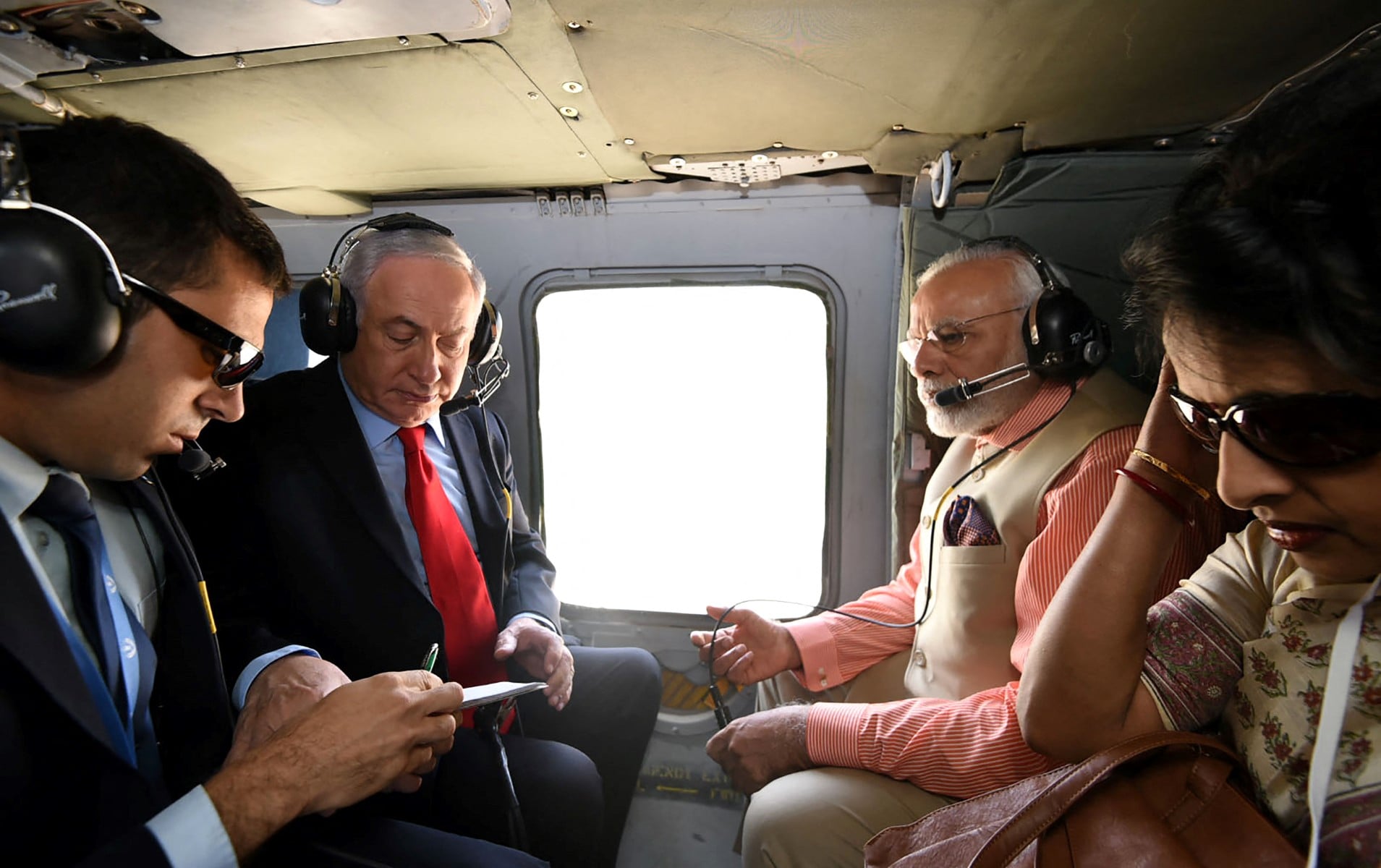
Prime Minister Narendra Modi and Israel Prime Minister Benjamin Netanyahu en route to Haifa in 2017 to pay homage to Indian soldiers who fought in the Battle of Haifa in the final months of World War I
Photo Credit: AFP
During the two-day visit, PM Modi is expected to address the Knesset, Israel’s parliament, a rare honour that underscores the political warmth between the two democracies. Earlier, former President Pranab Mukherjee had addressed the Knesset in 2015 during the first-ever visit by an Indian head of state to Israel.
He will also meet Israeli President Isaac Herzog during the visit.
PM Modi’s visit follows months of intensive diplomatic engagement between the two sides. External Affairs Minister Dr. S. Jaishankar and Commerce and Industry Minister Piyush Goyal have both visited Israel in recent months, while several Israeli ministers have travelled to India. Israel also sent a large government and private-sector delegation to the AI Impact Summit at Bharat Mandapam in New Delhi, highlighting growing convergence in emerging technologies, particularly artificial intelligence.
(With inputs from agencies)