

India-New Zealand FTA: India and New Zealand signed a free trade agreement (FTA) on Monday. The pact, which is likely to come into force later this year, will have to be ratified by the Parliament in New Zealand. New Zealand’s trade minister Todd McClay and India’s commerce minister Piyush Goyal signed the official document of the pact at Bharat Mandapam in New Delhi.
In New Zealand, the signed FTA will be reviewed by the Parliament’s foreign affairs, defence and trade committee (FADTC). Following a national interest analysis, which includes a public consultation, the committee will submit its report to Parliament for ratification. The process is expected to take at least six months. Follow Markets Live Updates
VIDEO | Delhi: Addressing a joint press conference with Union Minister Piyush Goyal, New Zealand Minister Todd McClay said, “Colleagues, we meet at a remarkable moment in the New Zealand–India relationship. In just a few hours, our two governments will take a significant step… pic.twitter.com/YFszKcUSFf
— Press Trust of India (@PTI_News) April 27, 2026
Earlier on Sunday, New Zealand Prime Minister Christopher Luxon confirmed the signing of the agreement. “It’s once in a generation agreement,” he said in a video post on X, adding that India’s rise to the world’s third largest economy would offer Kiwi exporters “unprecedented access” to a market of 1.4 billion people.
Significantly, negotiations for the trade deal resumed in March 2025 after a decade-long pause in talks. The negotiations were wrapped up by December 2025 — one of India’s fastest FTA processes. It is important to mention here that the pact has won bipartisan support from New Zealand’s major parties.
Here’s All You Need To Know About The India-New Zealand Free Trade Agreement:-
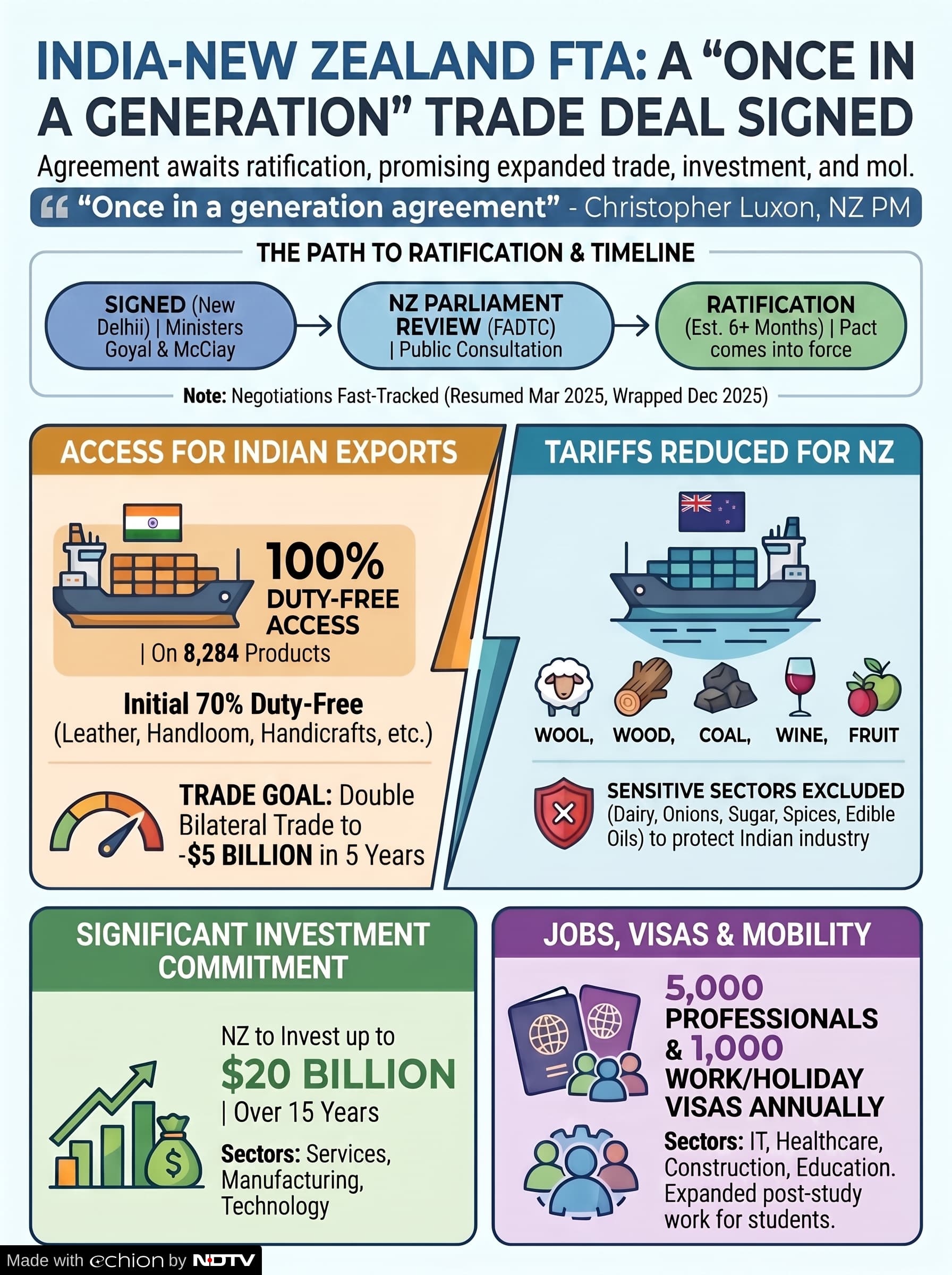
Duty-Free Access for Indian Exports
- Indian exporters will get 100 per cent duty-free access to the New Zealand market on 8,284 export products once the agreement comes into force.
- About 70 per cent of Indian goods — including leather, handloom, handicrafts and more — will enter New Zealand duty-free under initial terms.
New Zealand Exports to India
- New Zealand will eliminate or reduce tariffs on most of its exports to India — including wool, wood, coal, wine and fruit — boosting Kiwi farmer and export sectors.
- Some sensitive Indian sectors like dairy, onions, sugar, spices and edible oils are excluded from liberalisation to protect local farmers and industry.
Trade Growth Target
- The pact aims to double bilateral trade to about $5 billion over the next five years — a significant expansion from current levels.
Investment and Capital Flows
- New Zealand has committed to invest up to $20 billion in India over the next 15 years, according to government statements.
- This investment is expected across sectors including services, manufacturing, and technology.
Jobs, Visas and Mobility
- The FTA includes a visa pathway for 5,000 Indian professionals and 1,000 work and holiday visas annually.
- These visas will be available in sectors such as IT, healthcare, construction, education and more.
- Indian students and youth benefit from expanded post-study work opportunities under the agreement’s mobility provisions.
Once implemented, the pact will reshape trade, boost goods-and-services exchange, and deepen ties between the two economies. While there has been some apprehension regarding dairy imports from New Zealand, the government has assured that the industry will be protected.
Commenting on the pact, Ravin Saluja, Director, Sterling Agro Industries Limited, said, “The India-New Zealand Free Trade Agreement highlights the issue of dairy safeguards once again. New Zealand accounts for almost a third of all dairy trade across the globe, hence making it essential that India is protected by tariffs. Though the agreement does not ensure any direct imports of milk from the country, it might drive Indian companies to enhance their performance standards.”