

Ganga Expressway Inauguration: Prime Minister Narendra Modi will inaugurate the 594-km Ganga Expressway on Wednesday. Uttar Pradesh chief minister Yogi Adityanath was also present on the occasion.
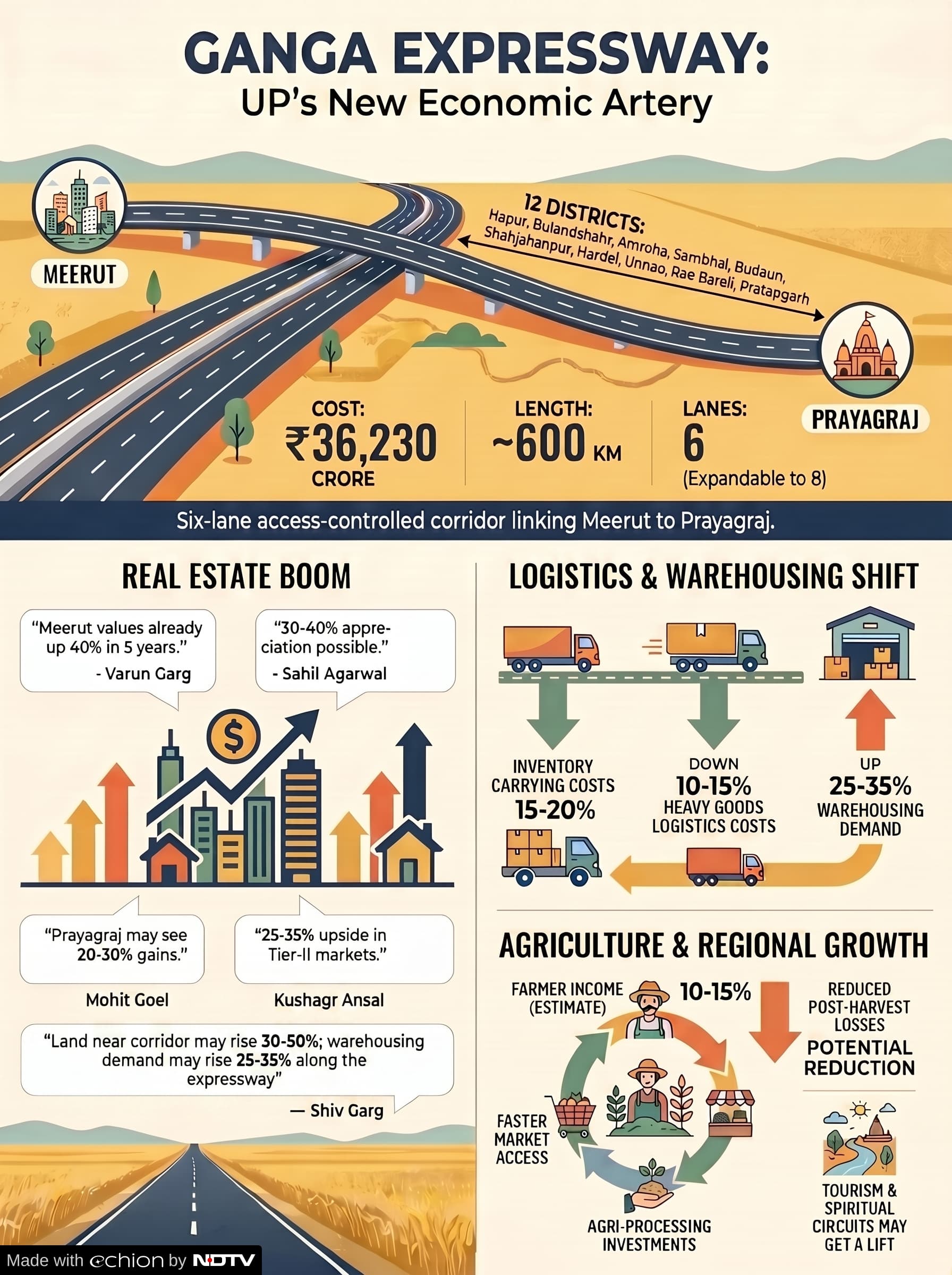
Built at an estimated cost of about Rs 36,230 crore, Ganga Expressway is Uttar Pradesh’s longest expressway and one of India’s biggest greenfield road projects. The six-lane access-controlled corridor, expandable to eight lanes, links Meerut to Prayagraj across 12 districts. It also comes with a much larger ambition — to function not just as a road, but as an industrial, logistics and development corridor.
For Uttar Pradesh, this is not merely a transport milestone. It is a test case in how infrastructure can drive manufacturing, logistics, real estate, agriculture and tourism at the same time.
Ganga Expressway: More Than Just Connectivity
The timing of the launch matters. The project comes as Uttar Pradesh pushes hard to position itself as an infrastructure-led growth engine. The expressway connects western, central and eastern UP. It cuts travel time between Meerut and Prayagraj from roughly 10-12 hours to 6-8 hours.
But the bigger story sits alongside the road. The state has lined up 12 Integrated Manufacturing and Logistics Clusters (IMLCs) along the corridor. Nearly 6,507 acres have been identified. Officials say 987 investment proposals worth nearly Rs 47,000 crore have already been received.
Ganga Expressway At A Glance
| Metric | Details |
| Length | 594 km |
| Cost | Rs 36,230 crore |
| Lanes | 6 (expandable to 8) |
| Districts covered | 12 |
| Land for industrial nodes | 6,507 acres |
| Proposed investments | Rs 47,000 crore |
| Investment proposals | 987 |
| Travel time | Cut 10-12 hours to 6-8 hours (between Meerut & Prayagraj) |
| Top Speed | 120 km per hour |
The corridor runs through Meerut, Hapur, Bulandshahr, Amroha, Sambhal, Budaun, Shahjahanpur, Hardoi, Unnao, Rae Bareli, Pratapgarh and Prayagraj. This geographic spread matters. It ties some of the state’s developed belts with districts that have historically lagged investment.
First Drive on Ganga Expressway: NDTV AutoMate Tests Meerut-Prayagraj Stretch Before Opening @sidnchips pic.twitter.com/0rCvgjmB7z
— NDTV (@ndtv) April 28, 2026
Ganga Expressway: Key Features
The expressway has scale. But its design features are equally notable.
1. Built as a multi-purpose corridor: This is not a pure mobility project. The government has pitched it as an expressway-cum-industrial corridor, integrating logistics parks, warehousing, agro-processing and manufacturing zones.
2. A manufacturing spine is being planned around it: The industrial cluster strategy is sector-specific. Different nodes are expected to focus on manufacturing, logistics, e-commerce, food processing and warehousing, based on district strengths.
3. Strategic defence utility: A 3.5-km airstrip in Shahjahanpur can support emergency fighter aircraft landings, giving the corridor strategic utility beyond civilian transport.
4. It plugs into a larger expressway web: Its importance rises because it links with or feeds into:
- Yamuna Expressway
- Agra-Lucknow Expressway
- Jewar Link Expressway
- Links towards Noida International Airport
- Proposed Haridwar connectivity extension
5. It is also being pitched as a manufacturing hub: The investment thesis is substantial.
| Indicator | Proposed Scale |
| Industrial nodes | 12 |
| Planned investment | Rs 46,660-47,000 crore |
| Manufacturing/logistics focus land | 2,635 hectares (industry estimates) |
| District-level industrial corridor | Entire 594-km route |
The idea is simple: roads attract traffic, corridors attract capital.
Ganga Expressway: Logistics, Real Estate, Industry, Agriculture
This is where the story gets bigger. Real estate could be an early beneficiary.
Varun Garg of Karyan Group calls the expressway “the backbone of UP’s economic story”, arguing it could lift land values across Meerut, Prayagraj, Kanpur and even parts of Uttarakhand. He points to over 40 per cent appreciation already seen in Meerut over five years and says Ghaziabad, backed by metro, Namo Bharat and expressway links, could see another layer of demand.
Sahil Agarwal of Nimbus Group also expects 30-40 per cent appreciation in some markets over the next few years, helped by connectivity to Jewar airport and the Yamuna Expressway. Similarly, Mohit Goel of Omaxe sees Prayagraj emerging as a major beneficiary, with 20-30 per cent appreciation possible in 3-5 years.
Another real estate expert, Kushagr Ansal, Ansal Housing, believes Tier-II cities could lead the next housing growth cycle, with 25-35 per cent upside in emerging micro-markets. Adding to this, Shiv Garg of Forteasia Realty says land within 5-10 km of the expressway could rise 30-50 per cent over four to six years.
However, the larger point is not speculative property gains. It is corridor-led urbanisation. Logistics may see the biggest structural shift. This may be where the biggest economic gains emerge.
Aman Gupta of RPS Group says reduced freight costs, faster turnaround and lower inventory costs could benefit sectors from FMCG to textiles. He estimates inventory carrying costs may decline 15-20 per cent. This matters in a country where logistics costs are often estimated at 13-14 per cent of GDP.
Raghunandan Saraf of Saraf Furniture puts it in operational terms. For bulky commerce like furniture and appliances, he expects transport routes to shorten by 40-50 per cent, while logistics costs for heavy goods may reduce 10-15 per cent. He sees the corridor helping build a new warehousing and delivery backbone for Tier-II and Tier-III India. He adds, “India’s e-commerce sector is estimated to be worth more than $200 billion by 2026. Most of the growth is going to be from non-metro centre cities. The corridor improves the supply chain of integrated stages.”
Shiv Garg also expects 25-35 per cent growth in warehousing demand along the corridor. Meanwhile, Aman Gupta argues districts like Shahjahanpur, Hardoi and Rae Bareli could see stronger economic activity as logistics improves. Better road access can matter as much for farm produce as for factories.
Varun Garg points to spillover benefits for Varanasi, Garhmukteshwar and Prayagraj’s Triveni Sangam. With temple-town investments also rising, tourism-linked commerce could become a secondary growth engine.
Ganga Expressway: Bridging The East-West Divide
Historically, western UP has been relatively prosperous due to its industrial ecosystem. On the other hand, eastern UP — largely dependent on agriculture — has lagged behind. By linking Meerut to Prayagraj, the all-weather Ganga Expressway is bridging the two regions with distinct economic profiles. This will lead to balanced regional development.
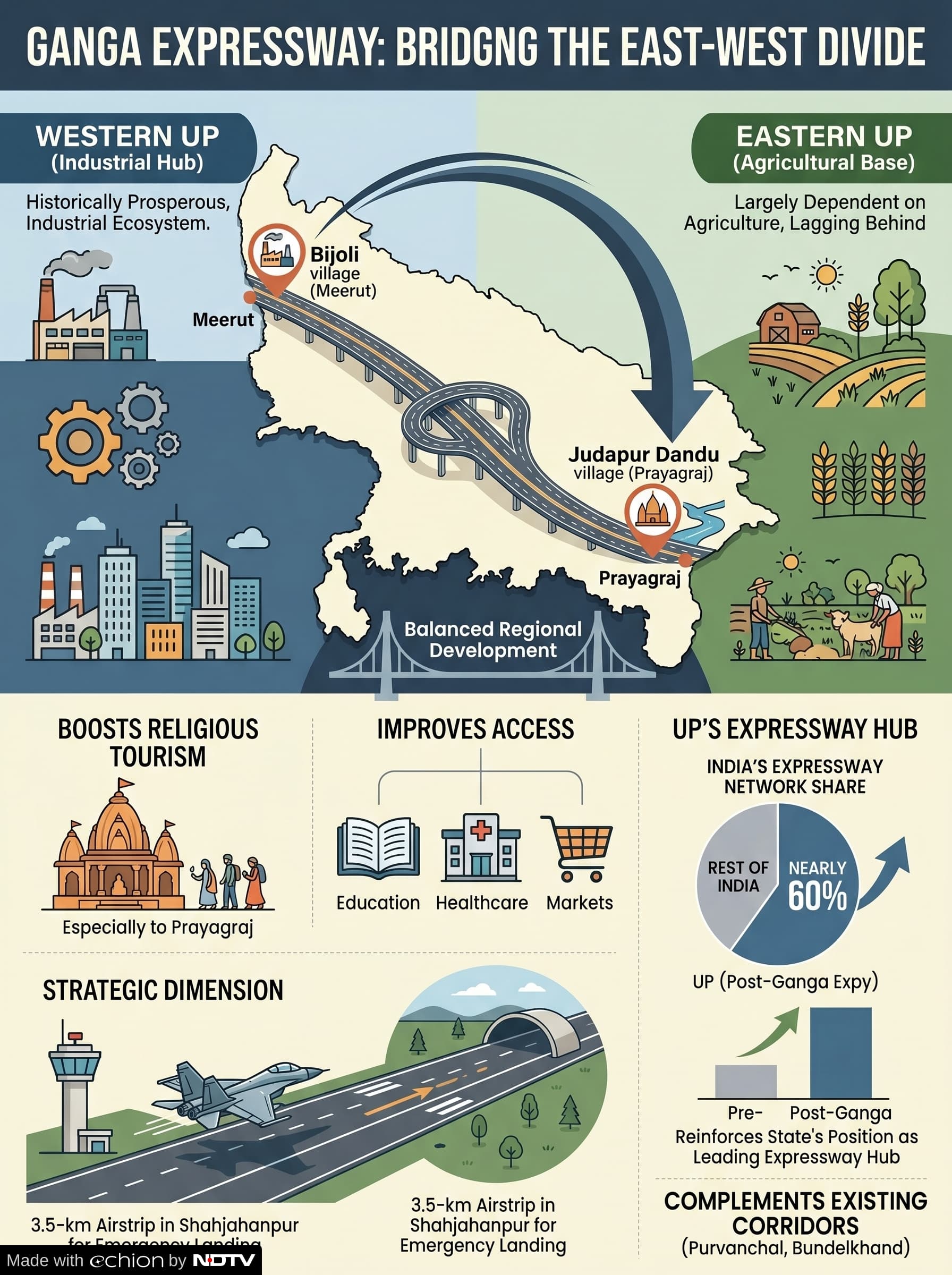
While every major expressway claims transformative impact, not all deliver equally. What may set Ganga Expressway apart is the attempt to pair road infrastructure with industrial nodes, logistics hubs, airport connectivity, warehousing and urban growth.
That makes it less a highway story and more a development corridor story. If even part of the Rs 47,000 crore industrial pipeline materialises, the project may end up reshaping far more than travel times. The Ganga Expressway may not just connect Meerut to Prayagraj. It may redraw Uttar Pradesh’s growth map.