

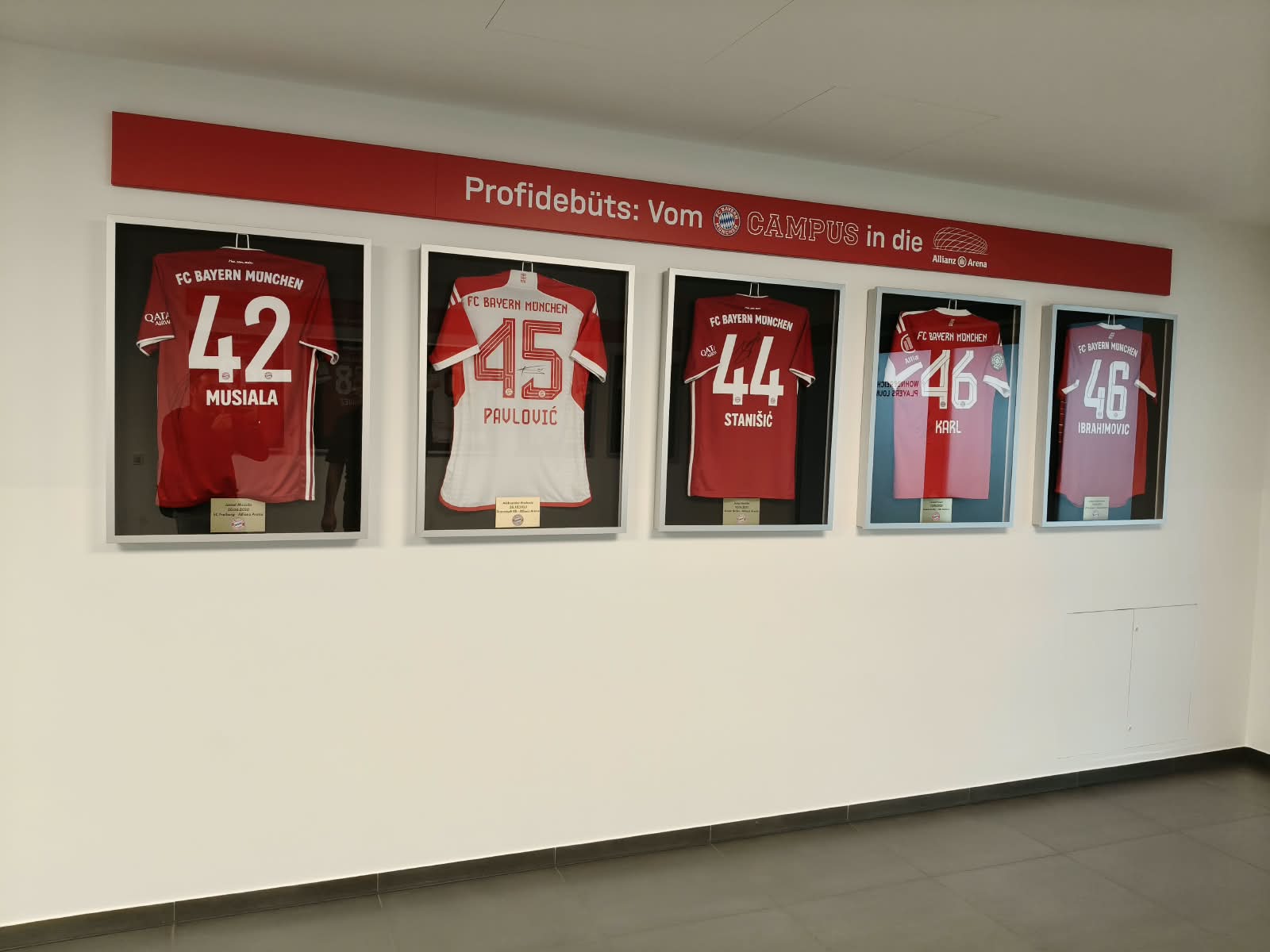
For a club like Bayern Munich, developing a footballer is about much more than producing a technically gifted player. At the Bayern Campus, the process involves footballing ability, physical development, personality, education and, perhaps most importantly, creating an identification with the club. During a visit to Germany, NDTV spoke to the club’s head of academy, Jochen Sauer, about how talent development, style of play, and philosophy pave the way for emerging stars like Lennart Karl, Aleksander Pavlovic and Josip Stanisic to seal promotion to a highly competitive first team like Bayern Munich.
Just like the first team, dominant football, possession, clear positional profiles and the expectation to win remain central to the Campus’ philosophy, but the academy insists that young players must also understand what it means to be part of the Bayern family. In a 3-part interview with NDTV, Sauer explained the thinking behind the club’s youth-development model, the qualities it looks for in young players, and how the Campus works with the first team.
While the rise of teenage attacker Lennart Karl has been one of Bayern Campus’ most recent success stories, there’s also the case of Kenan Yildiz, who left the academy to join Juventus in Italy and now has a market value of around 100 million euros. The Bayern academy chief explained how such cases are two sides of the same coin.
Over the years, Bayern have produced many one-club players. Philipp Lahm and Thomas Muller are unarguably the most recent examples. Though Bastian Schweinsteiger went on to play for Manchester United at the end of his career, his move is seen by many as a last hurrah more than a serious career decision. At the Bayern academy, there is a constant effort to build the same ethos in the players which were most recently found in Muller, who left the club last summer.
Q. What exactly is the FC Bayern way of football, and what are the core principles every player has to follow?
Jochen Sauer: If you want to be a professional football player, you need the technical and physical abilities to play at the top level. That is something all good academies have in common.
But if you want to reach the highest level, the personality of a player is also important. Young players should not concentrate only on football. Their schooling and learning in general also help them learn in football and, especially, develop their personality and character.
So we try to combine those three main topics. But what comes on top at Bayern Munich is “Mia san Mia”. Everybody has their own definition of it, but at Bayern it is about identity and identification with the club.
We try to give players a sense of what “Mia san Mia” means, what the Bayern family is and what is special about Bayern Munich compared to other clubs. What ultimately helps a player become a Bayern Munich player is dedication to the club.
Q. How important is that identification with Bayern?
Jochen Sauer: It is extremely important. Creating dedication and identification with a club is more than important. We want players to understand what the Bayern family is and what they need as Bayern Munich players to be part of that family.
That is something we value very highly compared to all the other skills players need. If you look at players such as Bastian Schweinsteiger or Philipp Lahm, they were so deeply connected with “Mia san Mia” that they never felt they wanted to change clubs.
I think Thomas Muller is another example. He is now experiencing a new world in MLS, but I think he would never have changed clubs within Europe. That dedication to Bayern Munich is something we try to develop in our players.
Q. How closely is the Bayern Campus’ playing philosophy aligned with the first team?
Jochen Sauer: I would answer that with yes and no. We need to ensure that Bayern Munich’s principles are in the DNA of our young players. But that doesn’t mean we change our curriculum every time the first-team coach changes.
What stands for Bayern Munich are principles that have lasted for the last 30 to 35 years. We want to play dominant football, we want to have the ball, we want to play as a team and we have very clear player profiles.
We always play with wingers and a central striker. Harry Kane is the striker now; before him it was Lewandowski, Mario Gomez, Luca Toni and others. The profiles remain similar even when coaches change.
Of course, with Vincent Kompany, some details are different from Louis van Gaal or Hansi Flick. But we have to make sure that when a player comes from the Campus to the first team, there are certain mechanisms that he already knows and that he understands what to do in his position.
Q. What qualities do you look for in young players?
Jochen Sauer: It is very difficult to identify at the age of 10, 11 or 12 which player will ultimately make it. A lot happens in the physical development of a young player, as well as technically.
We want players who show us some basics that make us believe that, if we do a good job developing them, they can reach the highest professional level.
We look for players who already show dedication to the game and have fun with the game. If a young player already sees football only as something he wants to do because he wants to become a professional, that is probably not what we are looking for.
We want players who see football as a game, who enjoy it and have dedication to it. They also have to understand the game: the target is to score goals, and you can score goals only if you play as a team.
You can have a player with extremely high individual qualities at 11, but if he doesn’t understand that football is a team game, it will be difficult for him to be successful at Bayern Munich.
Q. How do you balance winning titles and developing players?
Jochen Sauer: Both aspects are important. I would not be right if I said it is only about individual development and that winning belongs to the first team.
FC Bayern Munich is all about winning games and winning titles. If we don’t teach players that they need to win games and handle the pressure of winning during their youth, they will not be able to handle that pressure in the first team.
So it is a balance. But we are trying to make the players better. The consequence of having players who get better and better is that we become successful and win games.
The focus of the coaches is to make every player better. The consequence of having better players is winning titles and winning games.
Q. What made players like Lennart Karl, Aleksandar Pavlovic and Josip Stanisic ready for the first team?
Jochen Sauer: There is not one characteristic that makes a player a Bayern Munich player. The paths of those three players were very different.
Lennart Karl was part of the first team last summer, and nobody expected that he could have such an impact. He was thrown in because of injuries, and he performed. It had to do with quality, being at the right time and the right place, and also mental aspects. You couldn’t see any pressure on him in his first two or three games.
Josip Stanisic had a different path. He was not even a starting player in our second team when we played in the third division. But he was very patient. He believed he could make it at Bayern Munich, waited for his chance, and then took it.
What all three had in common was a desperation to be Bayern Munich players. They didn’t simply want to become professionals somewhere. Their biggest dream was to become professionals at Bayern Munich.
That belief, hard work, discipline, and dedication are what they need to be successful here.
Q. How closely do you work with Vincent Kompany and the first team?
Jochen Sauer: There is very close communication. We have the sporting department and people here who know the players in great detail, and there are regular meetings with members of the first-team coaching staff.
They discuss the development of individual players. The good thing about the first-team coaching staff is that they love seeing young players. Whenever they have the opportunity to integrate them into training, they do it.
Almost every player gets a chance to show himself in the first team. Then it is up to the player to make an impression, show his qualities, and impress the coach.
We know the first team’s squad planning and whether there is a need in certain positions. But the cooperation is very good. We want to present players who can train with the first team, and the first-team coaches want to see them.
It is an ongoing process. Some players are more nervous than others when they first train with the senior team, while players like Lennart Karl can show their qualities immediately. Overall, there is very good communication and cooperation between the youth department and the first team.
Q. Bayern have also lost players who went on to become stars elsewhere. What was your reaction to seeing Kenan Yildiz succeed at Juventus?
Jochen Sauer: I’ve been in football for almost 30 years, and I know there are always situations that are very difficult to handle, especially in talent development.
Seeing a player like Kenan Yildiz become successful at Juventus and have a market value of almost €100 million, you sometimes ask yourself, “Why has this happened?”
But honestly, you cannot avoid these situations.
At that time, we had a situation where we were probably too successful in that age group. We had five or six outstanding talents from the 2005 age group.
There was Arijon Ibrahimovic, Paul Wanner, Mathys Tel, whom we bought from Rennes, and Kenan Yildiz. They were all around the same age, played similar positions and had similar qualities.
Q. So why couldn’t Bayern give Yildiz the pathway he wanted?
Jochen Sauer: At that time, Julian Nagelsmann asked us: “There is no chance that I can integrate four 17-year-old players into the first team in similar positions. This is simply impossible, and we have to make a decision.”
Internally, we felt that Paul Wanner and Arijon Ibrahimovic were probably 10 per cent further ahead than Kenan Yildiz and needed to get the chance first.
Then an offer came for Kenan from Juventus. They could tell him that he could come to Juventus, train with the first team and play with the second team. We had offered that kind of opportunity to two other players, but we couldn’t offer it to him.
From his personal perspective, I think it was the right decision to change clubs. At that time, it was the right decision. Probably 12 months later, it would have been a different decision.
But these things happen all the time. In fact, they happen more often when you are doing good work, because then you have five or six outstanding players in every age group.

Ask Chelsea about Jamal Musiala. At that time, they decided that he wasn’t good enough at 16, and we could get the player.
Sometimes, if we look at Angelo Stiller, Kenan Yildiz, Malik Tillman, Joshua Zirkzee or Chris Richards, most of the time it was a situation where we had too many good players and had to make decisions.
As the head of the academy, I always say that this is probably a consequence of the better work we are doing here. Then I am not angry anymore when I think about those players and their situations.
Q. How difficult is it to tell a young player that he may not make the Bayern first team?
Jochen Sauer: You cannot compare one player with another or one player’s career path with another. Every situation is different, and you have to discuss every decision on the basis of the individual player.
Five years ago, we basically had only two options: keep the player for the first team or let him go. We had no other option.
Now, with our Red & Gold network and the environment of clubs we work and cooperate with, we can offer players different pathways.
Sometimes those pathways can even lead the player back to Bayern. Arijon Ibrahimovic is an example. He went through certain loan spells and is now part of the first team.
If you can talk openly and directly to a player and offer him different pathways, it becomes easier for him to decide what is best for him to become a professional and potentially return to Bayern Munich two or three years later.
Q. Uli Hoeness has called for Bayern to give more opportunities to academy players. What does that mean to you?
Jochen Sauer: It especially helps our players. If somebody like Uli Hoeness believes that we have quality here, that gives the players confidence that they can make it.
It also helps the coaches at the Campus because they feel that the club’s leadership believes they are doing a good job.
Every time a player gets a chance to train with the first team and makes it, like Lennart Karl, there is more trust from the first-team management and coaching staff that we have enough quality to integrate young players.
You don’t necessarily always need to transfer a player for a lot of money.
Vincent Kompany also plays an important role. He is one of the rare coaches who is brave enough to put young players into the team.
That is also part of his DNA as a player. He grew up at Anderlecht in an academy system where there was always a need to integrate young players. As a coach at Anderlecht, he did the same.
Q. At what stage do agents become involved in the careers of young players?
Jochen Sauer: Unfortunately, agents are becoming involved earlier and earlier. There used to be a situation where a 16- or 17-year-old probably had an agent. Nowadays, there are only a few players left who are 12 or 13 without some kind of adviser or agent around them.
Sometimes the advisers or managers are even the parents, which can be the worst case because they are not always objective.
The involvement also depends on the agent. Some are more involved in contractual matters, while others understand the football side and career pathway.
In a situation like Lennart Karl’s, when Michael Ballack was a player at the highest level, if you are discussing the player’s career pathway, you involve such an agent earlier.
For players starting at 16, I would say 99 per cent have an agent or at least their parents involved in discussions about development and next steps.
Q. What was the situation with Lennart Karl?
Jochen Sauer: Last year in March, I watched an Under-17 game with Michael Ballack, and we discussed Lennart’s next steps. We were talking about integrating him into the Under-19s and possibly sending him on loan to a higher league than the fourth division because we felt he wasn’t getting the right level of competition.
It was a very constructive discussion. But three or four weeks later, we were discussing integrating him into the first team!
Even Michael Ballack never expected that Lennart could become a first-team player six weeks after we had discussed potentially loaning him to a third-division team.
That shows how quickly things can change in football. It is an ongoing discussion.