

Oyo-parent Prism’s updated draft red herring prospectus (DRHP) for its upcoming IPO shows a company more dependent on foreign markets, and more exposed to old legal disputes, than its India-growth pitch suggests.
Beyond the headline numbers — restated profitability in FY24 and FY25 after a loss in FY23, a borrower base spanning India, the US and Europe — the risk factors section of the DRHP runs to nearly a hundred pages and lays out a company whose revenue base, legal exposure and capital structure should be looked at.
Heavy Dependence On The US And Europe
Revenue from operations outside India climbed to 83.77% for the nine months to December 2025, up from 74.70% in FY23. The US alone contributed 27.07% of revenue in the latest period — more than India’s 16.23%. Add the UK and Europe to it, and three markets make up 72.36% of its revenue.
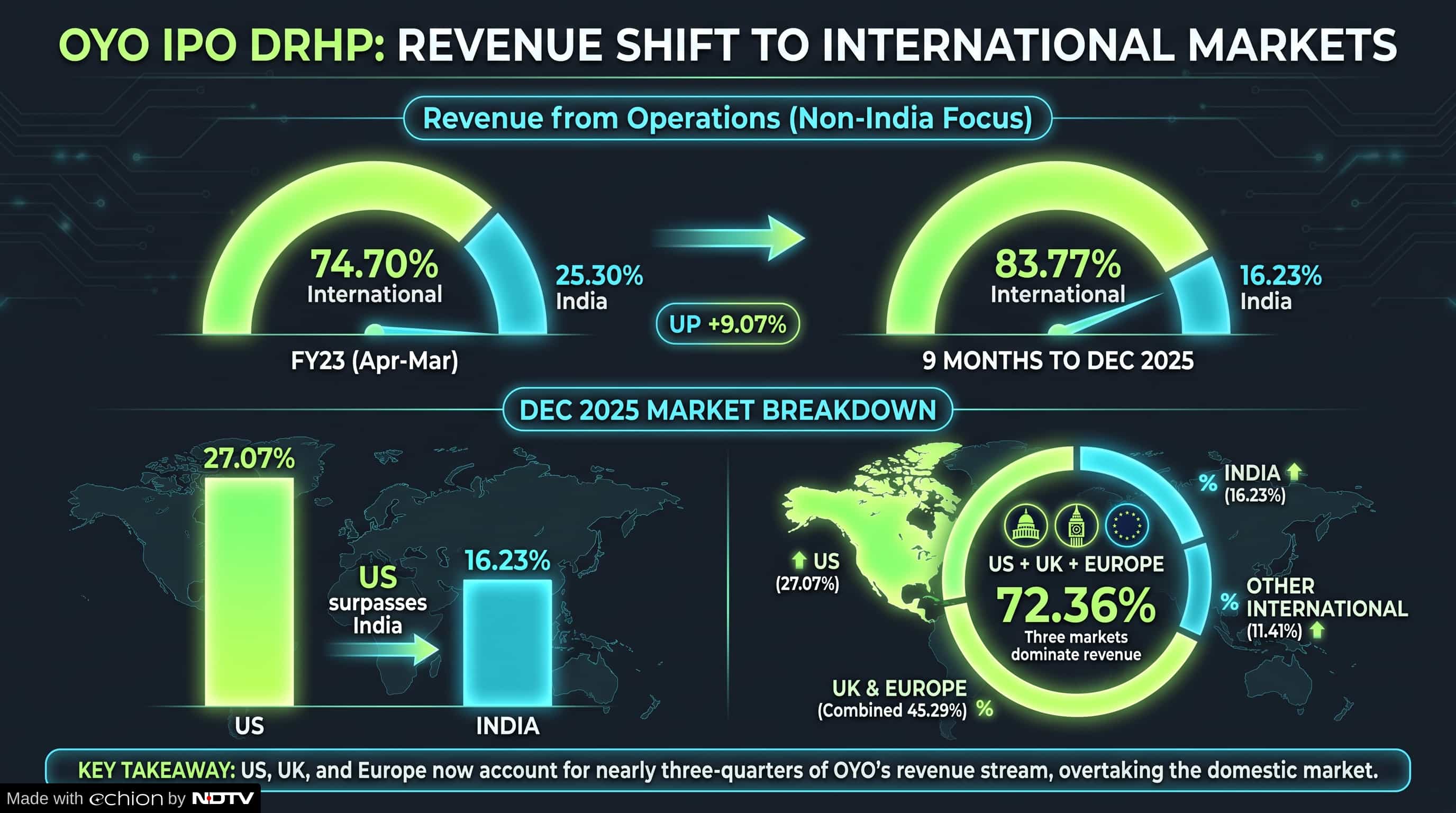
The DRHP says that any slowdown, policy shift or demand dip in these markets hits Oyo harder than a similar dip in India would, and the company “cannot assure” investors it will reduce this reliance.
The concentration has grown with the G6 Hospitality acquisition (which brought Motel 6 and Studio 6 into Oyo’s portfolio) and its earlier expansion into European vacation-rental brands like Belvilla — both of which tie Oyo’s fortunes to discretionary travel spending in developed markets currently cycling through inflation and slower growth.
The Zostel Case That Could Cost 7% Of The Company
A separate risk factor traces back to a 2015 acquisition attempt that never closed. Oyo had signed a non-binding term sheet to acquire Zostel Hospitality; the deal collapsed, with each side blaming the other for failing to finalise it. An arbitrator subsequently ruled that the term sheet was, in fact, binding.
Oyo challenged that finding before the Delhi High Court, which set the arbitral award aside on public-policy grounds — a decision Zostel has since appealed to a division bench under Section 37 of the Arbitration and Conciliation Act.
If Zostel eventually wins a non-appealable order, Oyo may have to issue or transfer up to 7% of its shareholding — or pay the equivalent in cash — to Zostel and other parties.
Profit Built On Cost Cuts, Not Just Growth
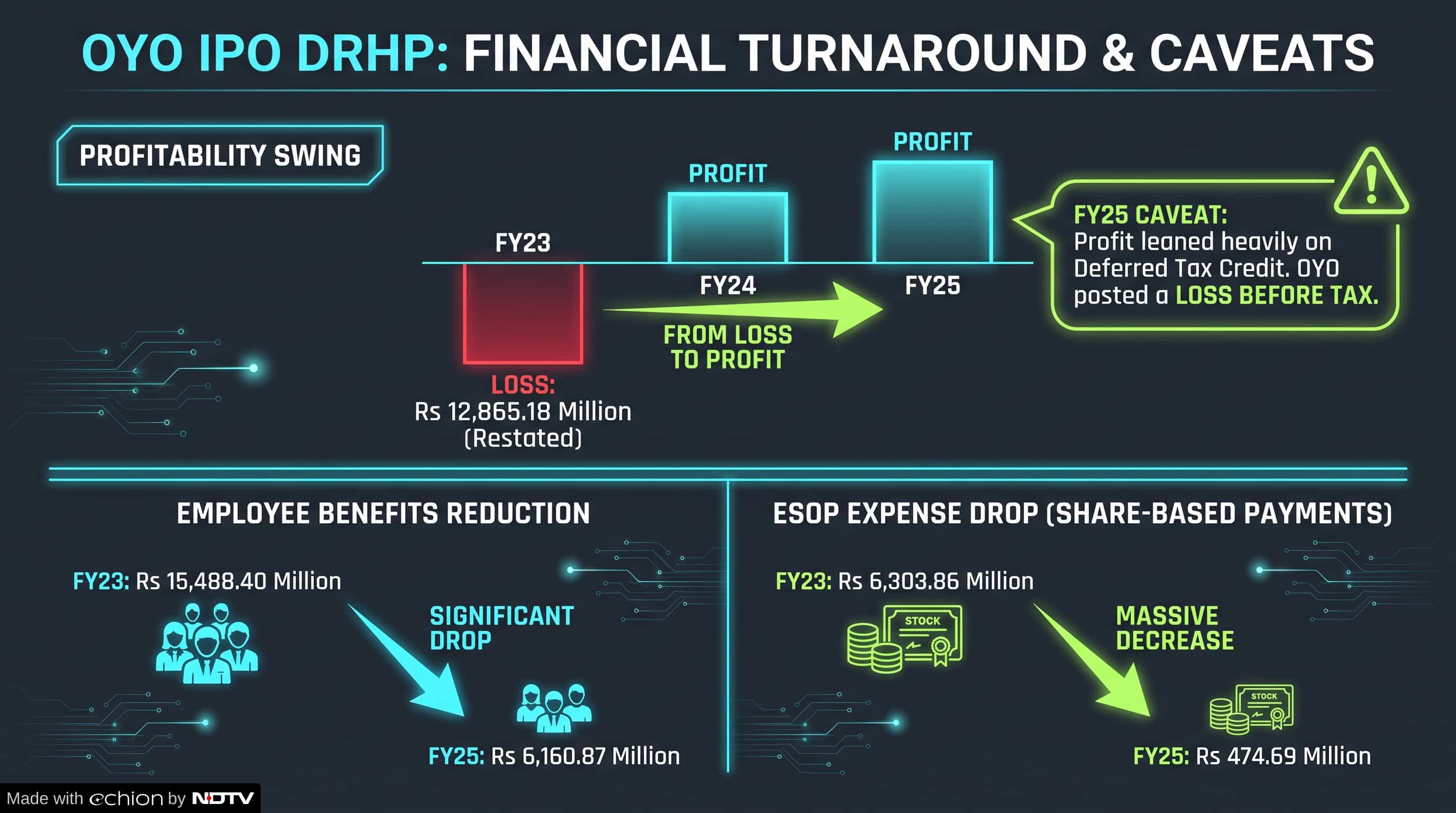
Oyo swung from a restated loss of Rs 12,865.18 million in FY23 to profit in FY24 and FY25. But the DRHP itself notes FY25’s profit leaned heavily on a deferred tax credit rather than operating performance — Oyo actually posted a loss before tax that year.
Over the same stretch, employee benefits expense fell from Rs 15,488.40 million to Rs 6,160.87 million, and share-based payment expense (the accounting cost of employee stock options or ESOPs) dropped from Rs 6,303.86 million to Rs 474.69 million.
Other Risks Worth Noting
InCred Capital, one of the book-running lead managers on the offer, discloses that its associates hold equity in Sunday Proptech Limited, a former wholly-owned Oyo subsidiary that was diluted into a joint venture via a shareholders’ agreement dated October 31, 2025, in the same window the IPO was being prepared — a potential conflict of interest the company flags itself.
Contingent liabilities (claims pending before courts or regulators that haven’t been provisioned for) stood at Rs 5,086.63 million as of December 2025, including a Rs 1,688 million matter before the Competition Commission of India.
Related-party transactions jumped from a steady 0.7-0.8% of total income through FY23 and FY24 to 4.73% in the nine months to December 2025, with no explanation offered in the filing.
Oyo also acknowledges that AI-powered travel agents and AI-enabled browsers pose a risk to direct bookings, and its own disclosures show that channel’s share already slipping, from 72.24% to 67.57% over the same period.
Its net worth, meanwhile, is built substantially from securities premium — capital raised through past share sales rather than earned profit — which has at times run more than ten times the company’s actual net worth; Oyo has not paid a dividend in three years and offers no assurance of one going forward.