

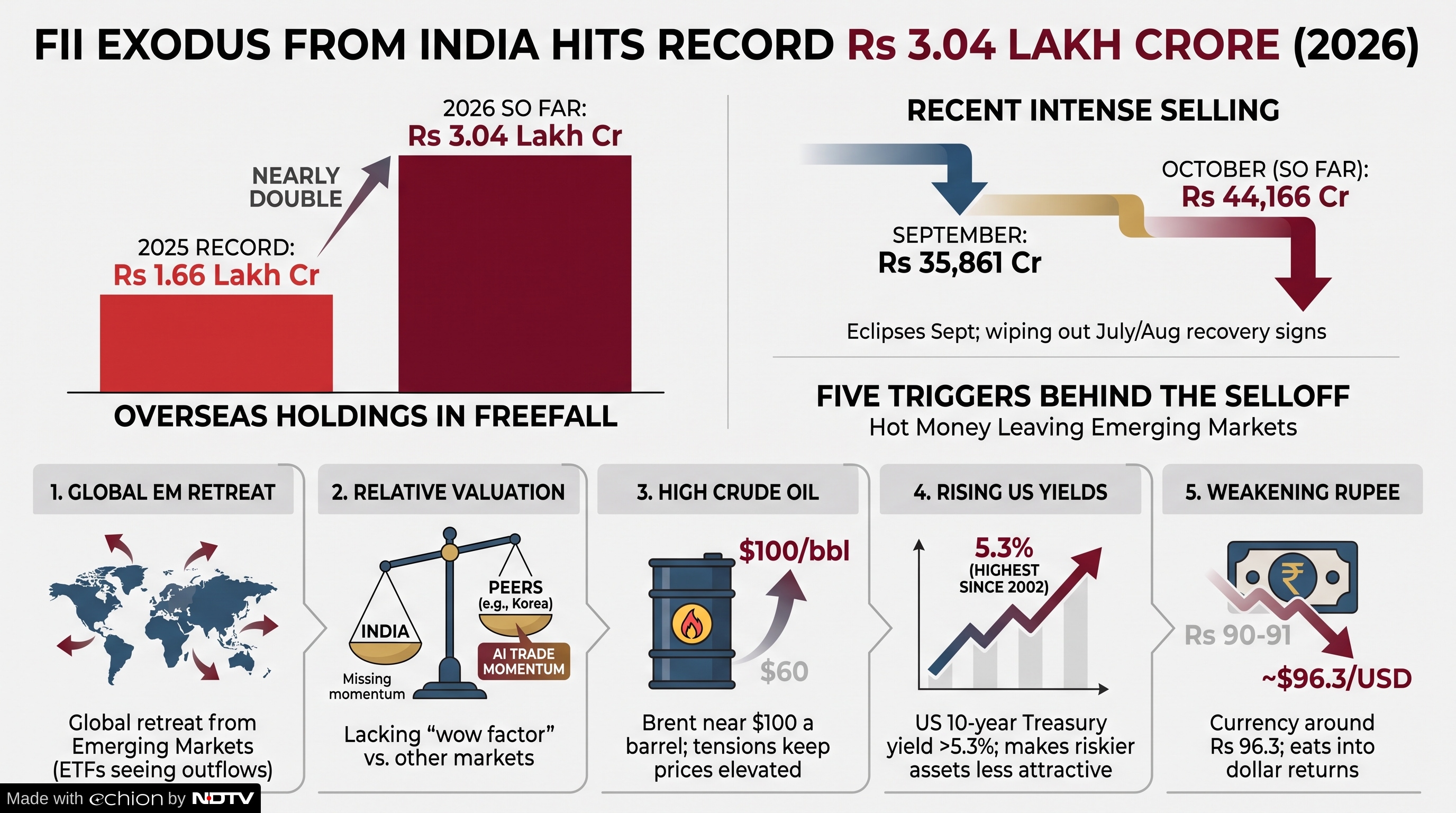
Overseas holdings in Indian equities is in a state of freefall, with the net FII exodus crossing Rs 3.04 lakh crore in 2026 so far. This nearly double as compared to the record Rs 1.66 lakh crore offloaded in 2025.
The Rs 3 lakh crore-mark was crossed after foreign institutional investors stayed net sellers on Friday, even as the markets staged a recovery. They net sold equities worth Rs 3,569 crore, even as the domestic institutional investors saved the day with a net mop-up of Rs 4,743 crore, according to NSE data.
The FII selling has been heavy throughout this month. Depository and exchange data showed FIIs sold Rs 9,232 crore on October 1, Rs 4,699 crore on Monday and Rs 6,121 crore on Wednesday, and Rs 12,944 crore on Thursday, when the Nifty 50 touched its lowest point of 2026.
In October so far, the net-selling has touched Rs 44,166 crore, per NSDL data, already eclipsing the Rs 35,861-crore exodus in September.
The FII activity over the past month-and-a-half has already wiped out the signs of recovery seen in the preceding two months, when a net mop-up of Rs 20,200 crore was recorded in July and Rs 30,919 crore in August.
ALSO READ: LIVE: Sensex, Nifty 50 Trade Flat; DMart Slips 4%; HCL Tech, Poonawalla Fincorp Gain
| Metric | Figure | Source |
|---|---|---|
| Net FII selling, 2026 so far | Rs 3.04 lakh crore | NSDL |
| Full-year 2025 outflow | Rs 1.66 lakh crore | NSDL |
| October so far (to Oct 9) | −44,166 | NSDL |
| September | −35,861 | Depository data |
| August (net buying) | +30,919 | Depository data |
| July (net buying) | +20,200 | Depository data |
So what is driving the exit? Kranthi Bathini, director – equity strategy, WealthMills Securities, says this is not an India-specific story. “Money has been exiting several emerging markets relentlessly,” he told NDTV Profit.
Five Triggers Behind The Selloff
1. Exit From EMs: The first is a global retreat from emerging markets. Hot money that had come into Indian markets is now leaving, Bathini said, and emerging market ETFs have been seeing outflows. With FIIs able to choose between several markets, India is competing for every dollar.
2. Valuation Battle: The second is relative valuation. Bathini pointed to how India stacks up against other emerging markets, with the Korea trade—where AI and related-themed stocks have given multibagger returns—a key reference point. Global equities are chasing momentum, he said, and India is missing the “wow factor” needed to attract that money.
3. Crude Jitters: The third is crude oil. Brent has hovered around $100 a barrel in recent weeks, up from near $60 at the start of the year, with tensions in the Middle East keeping prices elevated. “The comfort for the market, in the medium to short term, is crude oil. If oil prices ease, then FIIs may also make a comeback,” Bathini said.
4. Yields Pressure: The fourth is rising global yields. The US 10-year Treasury yield topped 5.3% in early October, marking its highest level since 2002. Bathini flagged elevated crude and an extended interest rate hike cycle as the key risks for large-caps, since higher yields make riskier assets like Indian equities less attractive.
5. Rupee Woes: The fifth is the rupee. The currency started the year near Rs 90-91 to the dollar and was around Rs 96.3 on October 1. A weaker rupee eats into the dollar returns of foreign investors, even when the stocks hold their ground.
Rotation, Not Retreat?
Not everyone reads the selling as a loss of faith in India. Dheeraj Gaur, Chief Investment Strategy Officer at Choice Wealth, was quoted as saying by India IPO that the pattern looks more like global asset allocation and risk management than a verdict on India’s domestic growth story.
Gaur said foreign investors are not switching off India but becoming far more selective. A firmer dollar and a weaker rupee reduce returns, he said, while dollar assets and technology-heavy Asian markets offer attractive alternatives. India, he added, has had to compete harder for incremental capital.
Markets Feel The Strain
The damage to prices has been visible. “Markets are volatile, and they have been breaking support levels every time,” Bathini said. Support at 24,000 and 23,000 on the Nifty has been violated in recent weeks and months.
The pressure has spread beyond the large-caps. Headline-driven volatility has also hit midcaps and smallcaps, he said.
For the coming week, Bathini is keeping a close eye on geopolitics, especially the Middle East, along with crude oil and the earnings season. Until those settle, he said, the exit of hot money from emerging markets is likely to keep weighing on Indian equities.
ALSO READ: Yields At 2002 Highs: Is 6% The Line That Could Shake Global Equities, And Who Gets Hit First?