

A joint petition filed by Congress leader Rahul Gandhi and several opposition leaders against alleged electoral irregularities and the Special Intensive Revision (SIR) of electoral rolls has 14 “defects”, the Supreme Court said, including a shortfall of Rs 220 in court fees.
Other errors cited by the Supreme Court are missing authorisations from nine petitioners and an illegible photocopy of Congress president Mallikarjun Kharge’s identity card.
Rahul Gandhi’s petition was filed today as thousands of people gathered in central Delhi and marched to the Supreme Court to challenge Chief Election Commissioner Gyanesh Kumar over allegations of electoral irregularities. While the INDIA bloc leaders marched, their legal team filed a petition against the poll panel chief over alleged “vote chori” (vote theft).
READ | SIR Stay, Action Against Officials: Rahul Gandhi’s 10 Requests To Top Court
Among the objections listed by the registry were the failure to attach certain “vakalatnamas” (written legal documents), a requirement to submit a clear copy of the identity card of Mallikarjun Kharge, and other discrepancies, including “small fonts” and the non-submission of “coloured copies” for two particular documents. The Supreme Court registry also noted problems involving dim or illegible text, missing pages, vernacular pages and discrepancies in numbering of certain pages.
The petition names the Election Commission of India (ECI), poll body chief Gyanesh Kumar and Election Commissioners Sukhbir Singh Sandhu and Vivek Joshi as respondents.
READ | Rahul Gandhi Leads Massive Rally In Delhi. Then A Supreme Court Visit
The petitioners will now have to address the “defects” for it to be listed for hearing in the top court.
What The Petition Says
The petition demands ten forms of relief regarding the SIR and other decisions taken by the Election Commission. NDTV accessed the details of the petition which has been listed as ‘Rahul Gandhi v. Election Commission of India’ on the Supreme Court website.
The ten INDIA Bloc demands in the petition are a directive to produce all records related to the SIR, examination of the constitutional validity of SIR decisions, action against responsible officials, redressal of the petitioner’s grievances, and a demand for an audit by an independent committee, among others.
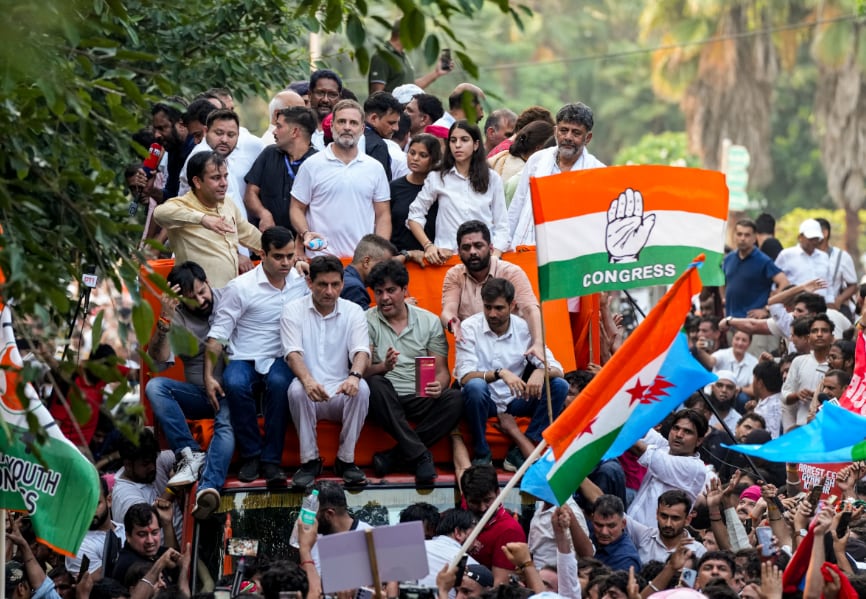
Karnataka Chief Minister DK Shivakumar, Congress leaders Rahul Gandhi, Imran Pratapgarhi and Deepender Singh Hooda, RJD leader Tejashwi Yadav, and others INDIA bloc leaders proceed in a bus towards the Supreme Court to file a petition against Special Intensive Revision (SIR) of electoral rolls and alleged poll irregularities during ‘March for Democracy’, in New Delhi, Monday.
Photo Credit: PTI
While the Leader of Opposition reached the Supreme Court in the evening, an hour or two earlier, the Congress legal team filed a petition at the top court, demanding ten forms of relief.
Monday’s march brought together a large number of Opposition leaders and supporters, who gathered in central Delhi before proceeding towards the Supreme Court. The Opposition’s decision to approach the Supreme Court followed an unsuccessful attempt to secure a meeting with Chief Justice of India Surya Kant.
READ | 13.6 Lakh Names Deleted During SIR. Punjab Now Has 2 Crore Voters
The INDIA bloc leaders had sought an audience with the Chief Justice to present a memorandum demanding an end to alleged vote theft, the resignation of Kumar, a halt to the SIR of electoral rolls and a return to paper ballots. The Chief Justice declined the request for a meeting, saying the matter was sub judice.
Before the march, however, Justice Kant said that the Supreme Court’s doors remained open to everyone, whether an ordinary citizen or an elected representative, when asked how opposition leaders could put forward their grievances.