

Share Market Crash: The stock market rally had given investors some reason to cheer last week. But the optimism did not last long. On Monday (October 19), selling pressure returned to Dalal Street, with a sharp fall in banking stocks and rising crude oil prices weighing on investor sentiment.
The BSE Sensex fell 1,000 points while the NSE Nifty 50 slipped 295 points by 2:30 pm. Both benchmark indices snapped their two-session winning streak. The weakness was not limited to large-cap stocks. The Nifty Midcap 100 and Nifty Smallcap 100 indices also declined. Meanwhile, investors lost around Rs 4 lakh crore as the total market cap of all BSE Sensex companies fell from Rs 4,72,62,167 crore (Friday’s close) to Rs 4,68,17,995 crore (2:30 pm Monday).
Several factors contributed to this sharp selloff. Weakness in heavyweight private banks, persistent foreign investor outflows and elevated crude oil prices kept investors on edge. FOLLOW MARKETS LIVE UPDATES
Why Did The Sensex Fall On October 19?
1. Heavyweight Bank Stocks Drag The Market
Private sector banks emerged as a major source of pressure on the benchmark indices after investors assessed their September-quarter earnings. HDFC Bank, ICICI Bank and Axis Bank were among the key drags on the Sensex. Together, the three lenders accounted for more than half of the index’s decline.
HDFC Bank shares fell nearly 3 per cent during the session. Investors were also looking for clarity on the lender’s senior management, including the appointment of a replacement for Deputy Managing Director Kaizad Bharucha. Axis Bank faced pressure after its quarterly performance fell short of market expectations on some key measures. Its shares declined around 5 per cent intraday.
The weakness also pulled down the private banking index, which fell 1.7 per cent. The selloff shows how the performance of a handful of heavyweight stocks can influence the broader market. Even when other shares hold steady, sharp losses in large index constituents can pull benchmark indices lower.
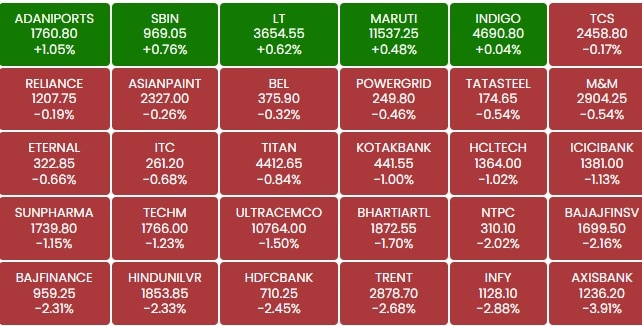
BSE SENSEX Heatmap At 2:05 PM On Monday.
2. Crude Oil Prices Remain A Major Concern
Oil prices continued to worry investors. Brent crude traded around $108-$109 per barrel during Monday’s session, despite easing from its recent levels. The surge in oil prices has been linked to supply concerns and tensions around the Strait of Hormuz, a crucial route for global energy shipments. Reports of attacks on tankers in the region have added to concerns about disruptions to oil flows.
For India, expensive crude can create problems on several fronts. The country imports a large share of the oil it consumes. Higher prices can increase the import bill, put pressure on the rupee and add to inflation risks. They can also hurt the profitability of companies that rely heavily on fuel and other petroleum products.
3. Foreign Investors Continue To Pull Money Out
Foreign portfolio investor (FPI) selling has been another source of pressure on Indian equities. Foreign investors had withdrawn around Rs 52,100 crore from Indian equities in October up to the latest available data cited in reports on Monday. This made the month’s outflows among the heaviest recorded this year.
The selling follows net withdrawals of Rs 35,861 crore in September. Higher crude prices, rising US bond yields and a stronger dollar have made investors cautious about emerging markets, including India.
When foreign investors sell shares in large quantities, the selling can weigh on stock prices and affect overall market sentiment. It can also put pressure on the rupee, particularly when capital outflows coincide with a higher import bill. The latest decline suggests that investors remain wary despite the recovery seen in Indian equities last week.
What Should Investors Watch Next?
According to Professor Abhinav Tripathi, senior economic expert, the immediate direction of the market will depend on a combination of corporate earnings, crude oil prices and foreign fund flows.
“Investors will closely track upcoming quarterly results for signs of strength in corporate profits and consumer demand. Banking stocks will remain in focus as the market assesses lenders’ margins, asset quality and management commentary,” he told NDTV.
Developments in the Middle East will also matter. A sustained rise in oil prices could keep inflation concerns alive and make it harder for Indian equities to regain momentum, he added.